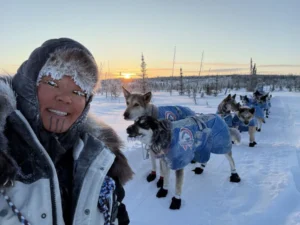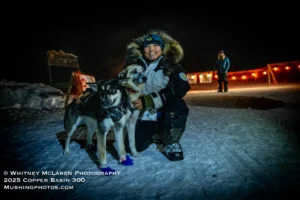
When you look at the 2026 Iditarod lineup, one name carries a very different kind of weight. Jody Potts Joseph has spent the last three years grafting away to qualify for this moment and she is about to step into something far bigger than a single long distance race. By getting to that start line, she becomes the first Gwichin woman to run the Iditarod and the first Alaska Native woman to enter the race since the early nineties. That alone makes her rookie year something special, but when you look at everything behind it, the story hits even harder.
Jody is not someone who wakes up one morning and just decides to try a thousand mile race. Qualifying takes years of planning and a stack of miles through some rough country. It means putting together a dog team that is strong in body and calm in the head, and then proving both musher and dogs can handle mid distance events in brutal conditions. She has been doing exactly that for about three years straight. Her time on the trails, travelling through the Interior and the Yukon flats, building the bond with her team, and running the qualifying races has brought her to the point where she finally gets the chance to line up in Anchorage with the rest of the field.
To understand why this is such a big moment, you have to look at what the Iditarod actually is. The race is known as the Last Great Race on Earth and it stretches from Anchorage up to Nome following roughly a thousand miles of frozen rivers, vast interior forest, mountain ranges and the western coast of Alaska. It runs every March and takes most mushers anywhere from eight to fifteen days to finish depending on weather, trail conditions and the strength of their team.
The event itself started in the early seventies, originally created as a way to honour and protect the tradition of dog mushing in Alaska at a time when snowmachines were becoming more common. But the roots go further back than that. For generations, dog teams were the only reliable way to travel long distances in Alaska during winter. Native communities used dogs for hunting, hauling and connecting isolated villages long before non Native settlers arrived. Mushing was as normal as walking and the people who lived off the land treated their dogs as working partners, family members and essential survival tools.
The most famous historical tie is the 1925 serum run when several teams carried diphtheria antitoxin to Nome during a deadly outbreak. Native mushers and their dogs played a massive role in that relay. They travelled through some of the most dangerous storms on record to save lives. Some families today are descendants of those mushers and that living history is woven into modern racing.
Even though the Iditarod is now a competitive sporting event with sponsors, media and prize money, it still relies heavily on the villages along the trail. Every checkpoint sits inside a Native community and the race cannot function without them. Local volunteers open schools and community halls to mushers, help with dog care, and provide knowledge of the land and weather that no GPS can match. The trail itself is shaped by Indigenous history. The old mail routes, trapping routes and winter travel lines used by Native families are basically the backbone of the Iditarod trail.
That is why Jodys rookie run means so much. She is stepping onto a trail that holds deep meaning for Alaska Native peoples yet has not seen an Alaska Native woman racing it in more than thirty years. Representation in the sport has always been a bit uneven and seeing someone from the Gwichin community take her place among the field is a powerful reminder of where mushing truly came from. It is not just heritage for her. It is part of her identity and the landscape she grew up in.
Running the Iditarod is hard for anyone. It demands long nights with no sleep, rough storms, blizzards that erase the trail, and stretches of total isolation where it is just you and the dogs moving through the dark. A rookie usually enters with a goal of finishing safely and learning from the trail. Jody will be doing all of that while carrying the pride of her family and community with her. Her journey shows what real commitment looks like. Three years of preparation all building toward one moment on the start line of Fourth Avenue in Anchorage.
When she leaves Anchorage and heads toward Willow for the restart, she will not just be another rookie number. She will be part of a much bigger story about Indigenous women reclaiming space in a sport that was shaped by their ancestors. Her presence on the trail will be something a lot of people will remember for a long time, especially young Native kids who might grow up seeing her and believing they can do the same.
The 2026 Iditarod will have plenty of strong mushers, tight competition and dramatic weather. But Jodys run adds something deeper. It reconnects the race with its cultural roots and reminds everyone watching that dog mushing is not just a sport. It is part of the history of Native Alaska and part of the future too.
Richard Bailey